 Minou
MinouIn short
- Search close by first: inside your home, then around it, quietly.
- Tell your immediate neighbours and ask them to check their garage, shed and basement.
- Start an alert with Minou: it's free and can notify neighbours who turned on alerts.
- Call your city's shelter or animal services, then call back regularly.
- Put up posters, and check the details linked to your cat's microchip.
In the first hour
Search your home and around it
Closets, basement, garage, shed, under balconies, stairs and cars. A frightened cat goes silent and stays still: look, don't wait to hear them.
Call them calmly
Walk slowly around the block, in a normal voice, shaking their food box. Stop often to listen.
Tell your immediate neighbours
Ask them to check their garage, shed and basement, and to keep an eye out, even if they haven't seen your cat.
With Minou
Start an alert, even if you're not at home
A photo from your gallery, their name, and the alert goes out. It can notify neighbours near you who turned on alerts. It's free.
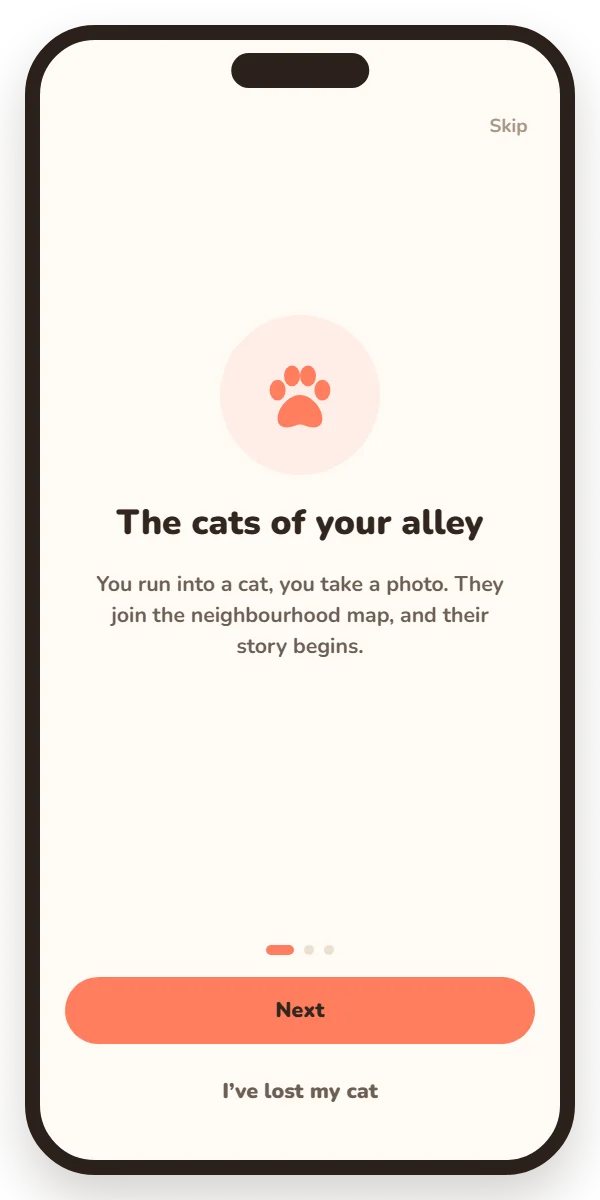
In the latest version of the app, tap this button: on the welcome screen the first time you open it, or in search (the magnifier on the map) if the app is already installed



The first evening and night
- Search again when it's quiet, at dawn for example: a frightened cat answers a familiar voice more easily when the street is calm.
- Put used litter outside, around your home and in the bushes. The familiar smell may draw your cat back. The Montreal SPCA suggests repeating it every two days.
The next day
Call your city's shelter or animal services
Report the disappearance and ask whether your cat has been brought in. Call back regularly, and check the list of found animals on their website if they publish one. In Montreal, that's Proanima: 514-379-2525.
Put up colour posters
A recent photo, a description, your number. Near where your cat was last seen, and at vets, pet stores, convenience stores and grocery stores nearby. The Montreal SPCA suggests laminating them against rain and snow.
Post a notice
In your neighbourhood Facebook groups and on lost pet listing sites.
Tell your local police station
As the Montreal SPCA suggests.
Check the microchip
If your cat has one, check that your details are up to date with the registry where the chip is recorded.
The following days
- Keep searching, at different times of day.
- Also fill in the Montreal SPCA's lost animal form, and check its list of found animals.
- To take your cat home from a shelter, you usually need proof that they are yours (a vet bill, a photo of their tag) and to pay boarding fees. That's the case in Montreal.
What Minou's alert does, and what it doesn't
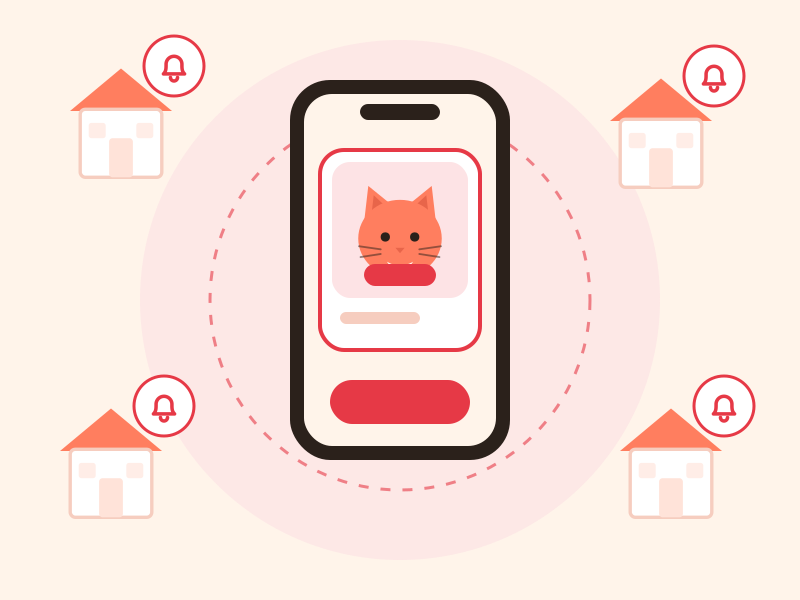
- It can notify neighbours near you who turned on alerts, with a message that gives neither your cat's name, nor your address, nor your number.
- Your cat's card turns red. When a neighbour photographs your cat after the alert starts, you see where, as soon as the photo is recognised or validated.
- It doesn't replace calling the shelter or putting up posters. And it only reaches as far as the neighbours near you who have Minou.
Frequently asked questions
Does Minou's alert cost anything?
No. The alert is free.
I don't have a recent photo of my cat. Is that a problem?
No. A photo from your gallery is enough, as long as your cat can be recognised.
I'm not at home. Can I still start the alert?
Yes, in the latest version of the app: "I've lost my cat" asks whether you're at home, and the alert goes out even if you're elsewhere.
Is the whole neighbourhood notified?
No. Only the neighbours near you who have Minou and turned on alerts.
Sources
- Montreal SPCA, some tips to help you find a lost animal.
- City of Montreal, report a lost or found animal.
Checked on October 16, 2026.
Your cat just went missing?
Install Minou and, in its latest version, tap "I've lost my cat": a photo from your gallery, their name, and the alert goes out. It's free.